Twelve minutes of blocks, then twelve minutes of fine
The picture went blocky on a still screen, stayed that way for a while, and came back on its own. 0.46.0 shipped a watchdog for it. 0.46.1 has the cause, and the watchdog was the wrong answer.
What it actually is
esp_h264 is Espressif's H.264 component. Its rate controller keeps a running total of encoded bits minus allowed bits, one addition per frame, in an int32 that nothing bounded.
A still screen at 1080p and 4 Mbit/s is allowed about 133,000 bits a frame and produces about 700. So the total goes down by 132,000 every frame. At 22 frames a second it reaches INT32_MIN in about twelve minutes, and wraps.
After the wrap the controller reads an enormous overspend, so it raises the quantiser by one step per frame until it hits the ceiling. That is the blocks. Twelve minutes later the counter wraps back and the picture heals itself.
Everything I had measured falls into place at once. Nothing settable moved it, because nothing settable touches that counter. A new encoder cleared it, because a new controller starts at zero. And raising the bitrate did not help because a bigger budget means a bigger gap every frame - it makes the wrap come sooner.
There is a second bug in the same function. The clamp on the other error term is written CLIP3((int)err_sum, -5, 5) while the macro is CLIP3(min, max, v), so it evaluates 5 > -5 for every input and returns the constant -5. That term never did anything.
Checking it on hardware
A theory that explains what you already saw is cheap. This one makes a prediction: the time to the wrap is inversely proportional to the configured bitrate. Triple the bitrate and the collapse should arrive three times sooner.
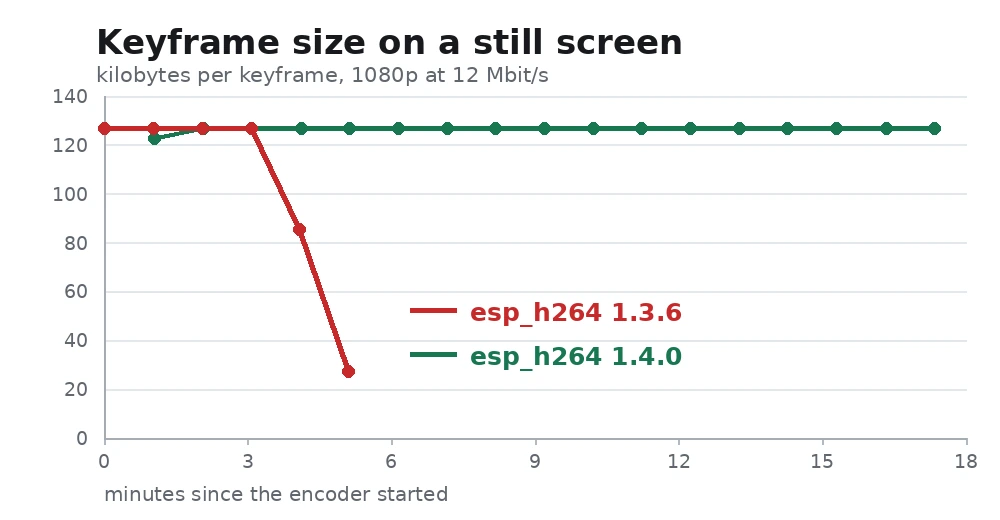
So: 12 Mbit/s instead of 4, still screen, watchdog switched off, and watch the keyframes.
The keyframes sat at 126.6 KB for four minutes, then 85.4, then 27.2. Predicted 244 seconds, measured between 184 and 245. At 4 Mbit/s the same collapse takes twelve minutes. That is the cause, not a correlation.
The green line is the same seventeen minutes after the fix.
The fix
Espressif had already fixed it. esp_h264 1.4.0 widens the counter to 64 bits, saturates it at one second of budget, and corrects the argument order in that clamp. I was on 1.3.6 because the version was pinned in the lock file.
So the fix is one line: the floor moves to ^1.4.0. No fork and no patch.
The watchdog was dangerous
0.46.0's guard rebuilds the encoder when keyframes collapse. Twice yesterday that rebuild failed and took H.264 with it - the device fell back to MJPEG and stayed there until a restart.
The encoder's reference frame wants one contiguous block of internal RAM, about 135 KB at 1080p, and the component has no PSRAM fallback for it. Releasing a 135 KB block does not reliably leave a 135 KB hole: the log caught it at 314 KB free with the longest run 132 KB. Three kilobytes short, and the codec is gone.
The guard stays, because a net that never fires costs nothing. But it measures what the encoder took on the open that worked - 155 KB on this board - and refuses to rebuild unless that much is free in one piece. A picture in blocks is better than no picture at all.
Two more, found while chasing it
The mouse jiggler had never worked. It nudges the pointer one pixel and straight back so the target counts it as activity. The input queue coalesces motion that is waiting to go out, which is right for a hand on a mouse and wrong here: the two halves added up to zero and the target received a report with no movement in it, which its input layer drops. The counter said 1245 nudges while the screen it was meant to keep awake went dark anyway. Two nights of watching measured nothing because of it. A nudge is now marked so it cannot be folded into its neighbours, and the target stayed awake for the first time.
A console tab left open erased the log. When its session expires the tab keeps reconnecting every thirty seconds, which is deliberate. Each refused socket wrote two warnings, though - 875 of them overnight, enough to flush the 200-line log ring in under an hour. So the log I was keeping to catch the video fault no longer had the video fault in it. The refusal is logged once and then at most once a minute with a count of what it skipped.