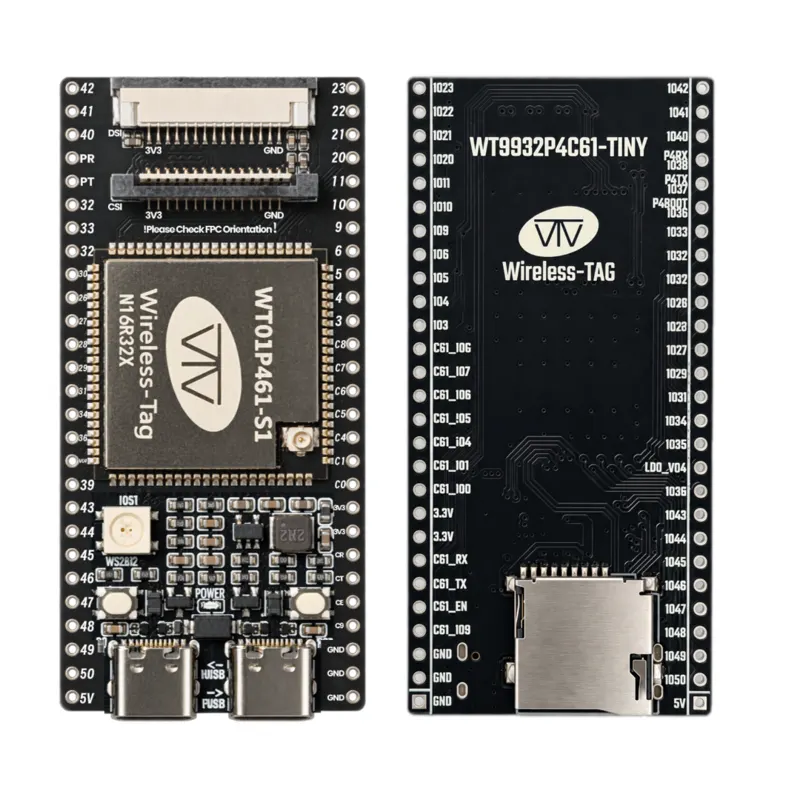
What ESP-KVM needs from a board
- ✓ 32 MB of PSRAM. It has the 32 MB of PSRAM the video needs.
- ✓ A camera connector the capture board fits. The HDMI capture board's Raspberry Pi camera ribbon fits its camera connector. Connector: 15-pin, Pi order.
- ✓ High-speed USB towards the target. Its high-speed USB comes out where it can face the target as a device.
- ? A network. How it would reach the network is the open question, see above.
Read from the maker’s documents, checked 2026-11, not from a board in hand.
The WT9932P4C61-TINY is a narrow board for a breadboard, built on the WT01P461-S1 module. The module has an ESP32-P4 rev 3.x with 32 MB of PSRAM and an ESP32-C61 for 2.4 GHz Wi-Fi.
The capture side fits. The camera connector J2 is a 15-pin 1.0 mm one, and Wireless-Tag says it uses the Raspberry Pi pin order. The high-speed USB has its own USB-C socket, J10, with the 5.1k CC resistors of a device port. The other USB-C socket, J9, is the full-speed port on GPIO 24 and 25. There is a microSD slot.
The network is the problem. There is no Ethernet, and the C61 talks to the P4 over SPI. ESP-KVM only runs Wi-Fi chips over SDIO today, so this board needs SPI support for the co-processor first.
Have one?
One request is enough: I add a board as soon as someone who has it can try a test build.
- Open a board request in Discussions. The form asks for the board's shop page, its schematic if there is a link, the chip marking and the capture board you have.
- I make a test image from the schematic and post it in the thread.
- You flash it on the flasher with Install another version from a file, and tell me what works. The flasher's Back up the flash keeps the board's old firmware.
- Once the picture, the keyboard and the network work, the board goes into the catalog with its own image and updates.