0.69.0 and 0.69.1 - Faster memory, faster H.264
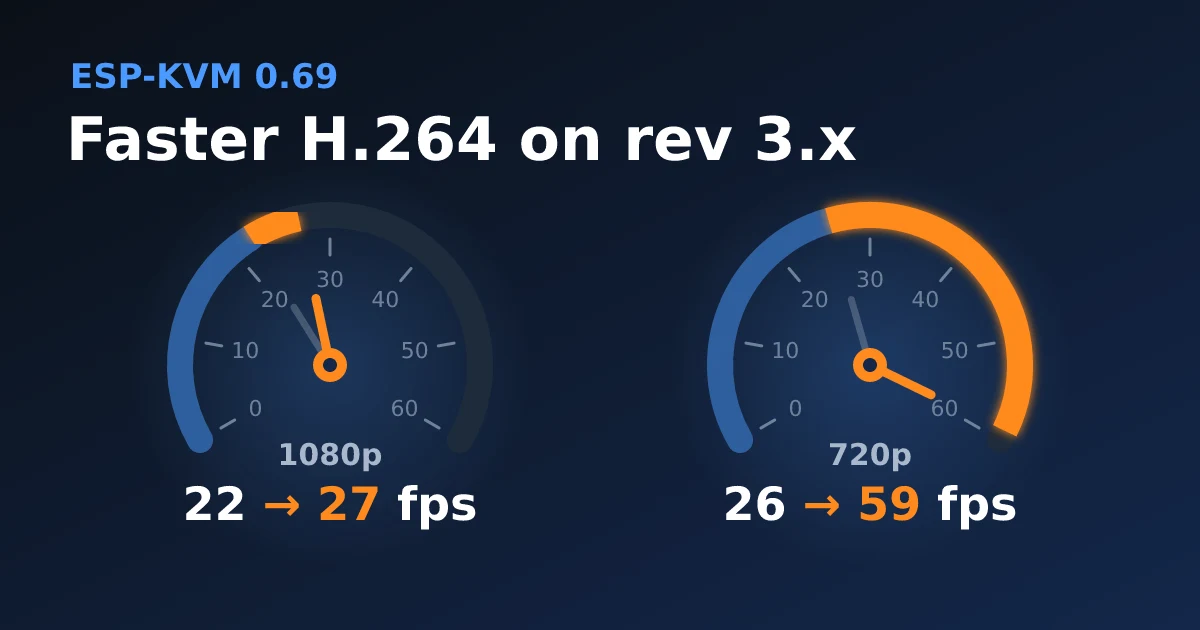
On a rev 3.x chip, 1080p H.264 ran at 22-24 frames a second. I wanted to know what holds it there.
The encoder was busy 96-99 % of the time, so it is the limit. A 1080p frame took 43 ms. For each frame the encoder reads the picture and a reference frame from PSRAM and writes the result back, so I looked at the memory first.
250 MHz instead of 200
The PSRAM sits inside the ESP32-P4 package. On rev 3.x chips it can run at 250 MHz; on rev 1.x the limit is 200, and the build system does not offer more. With 250 MHz a frame takes 36 ms instead of 43.
I measured both builds on the same Function EV, one after the other, with "Measure the delay" in the console: the pointer moved on the target until the browser shows it. The H.264 went over WebRTC.
| 1080p H.264 | 200 MHz | 250 MHz |
|---|---|---|
| Encode a frame | 43 ms | 36 ms |
| Frames a second | 22.5 | 26.5-27 |
| Delay, same network | 150 ms | 118 ms |
| Delay, phone network over Tailscale | 190 ms | 174 ms |
The delay drops by more than the 7 ms the encoder saves: with frames closer together, the pointer's move gets into a frame sooner too. Over the phone network the two measurements did not get the same connection: the round trip was 23 ms while I measured the 200 MHz build and 43 ms while I measured the 250 MHz one. The 250 MHz build was faster all the same.
At 720p a frame encodes in 16 ms instead of 18.5, and the delay goes from 79 to 67 ms. The frame rate stayed at about 26, and the encoder was busy only 41 % of the time. More on that below.
It is one line in the build settings of every rev 3.x board. Builds for rev 1.x chips are the same as before.
I ran it for ten minutes of 1080p video and then a night: 37 °C under load, no errors, no restarts. I tested it on the Function EV. The other rev 3.x boards have the same chip and memory inside it, so they should get the same.
Where 30 is
Espressif gives 30 frames a second at 1080p for this encoder, but with YUV420 input, 12 bits a pixel. The HDMI bridge sends YUV422, 16 bits. I tried giving the encoder YUV420: it was 13 % faster, not the 25 % the smaller frame suggests.
The rev 3.x chip has a block in the camera input that should turn YUV422 into YUV420 on the way in, for free. I could not get it to write anything in that mode. The other way is a second pass through the memory, and memory is what is short here. So it stays at 27 for now.
0.69.1: 720p at 59
720p stopped at 26 with the encoder half idle. With the frame rate limit raised from 30 to 60 in the settings it went to 51-54 at once. So the limit held it, and the limit also counted wrong.
The source sends 60 frames a second, a frame every 16.7 ms. With a 30 fps limit every second frame should go out, 33.3 ms after the last one. The check threw away a frame that came a fraction of a millisecond early, and then the next one went out after 50 ms. On average that gave 25-26 instead of 30.
Now the device keeps a schedule: every 33.3 ms the next frame is due, and a frame that comes a little early is taken. With the limit at 30 it gives 30.0, with the limit at 60 it gives 59.
The default limit is now 60. If you set the limit yourself, your value stays. 1080p does not change: the source sends 30 frames a second, and the encoder manages 27 of them.
One trap with the higher limit: the encoder shares the bitrate out by the frame rate it is told. Told 60 while the source sends 30, it gives each frame half the bits. So the encoder now gets the lower of the two, the limit and the source's rate.
| 720p from a 60 Hz source | 0.69.0 | 0.69.1 |
|---|---|---|
| Frames a second | 26 | 59 |
| Encoder busy | 41 % | 93 % |
| Delay, same network | 67 ms | 70 ms |
The delay stayed about the same; the spread between tries is bigger than the difference.
Comments