0.49.0 - microSD at full speed
Until now the microSD card was the slow part of this KVM. I wrote it off as a limit of the ESP32-P4 and put it in the README. It was not a limit of the chip. It was three problems in my firmware, and all three are fixed.
Before and after
| Before | After | |
|---|---|---|
| Function EV, card bus | 4 MHz | 40 MHz |
| Function EV, card read | ~1.5 MB/s | ~8.5 MB/s |
| Function EV, card write | ~780 KB/s | ~4 MB/s |
| P4-ETH, card bus | 4 MHz | 40 MHz |
| P4-ETH, card read | ~1.5 MB/s | ~9 MB/s |
| P4-ETH, card write | read-only | ~4 MB/s |
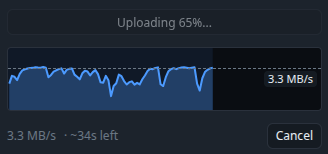
| Upload from the console, Function EV | 64 KB/s | ~3.5 MB/s |
| Upload from the console, P4-ETH | not possible | ~1.5 MB/s |
| A 2.7 GB image through the console | about 12 hours | 21 minutes |
Uploads are over Ethernet. Before, the P4-ETH card had to be filled in a card reader.
The card had no power on its pins
On both boards the pins of the card slot get their power from one of the chip's own regulators, LDO 4. My code never turned it on. The card still answered, so it looked like a slow bus. Reads failed above 4 MHz, and on the P4-ETH's rev 1.3 chip every write timed out.
With the regulator on, the card runs at 40 MHz on both boards, and the P4-ETH writes. I checked the writes with CRC: files of 64 MB of random data came back byte for byte.
Uploads waited for a timer
An upload came in at 64 KB/s whatever the network. The TCP receive queue held six packets. When a burst filled it, the network stack dropped the rest until its next timer, 125 ms later. Six packets every 125 ms is 64 KB/s. The queue now holds a whole TCP window. The card is also written by a separate task, so the network does not wait while the card writes.
The SD driver
Now and then a write never finished, and the SD controller then took no command at all. I found several bugs in the SD driver from ESP-IDF 6.1 and keep a fixed copy in the project. A failed transfer now resets the controller, stops the card and is tried again.
Every card gets its own speed
Boards and cards differ, so the device does not trust one number. It starts at the fastest clock the board allows and steps down to 20, 10, 4 and 2 MHz when the card fails. When the card is idle, it tries one step up again. The Media panel shows the speed it settled at, and Settings can cap it.
Pause the video while you upload
The video encoder and the Ethernet chip share a bus inside the chip. At full frame rate the upload drops to a tenth. So during an upload the video goes down to 2 frames a second, and the Media panel has a link to pause it for the full speed.
The other boards are not checked yet. They start at 4 MHz, as before. If one of them has the same regulator wiring, it will get the same speed.